

Forging
Special forgings
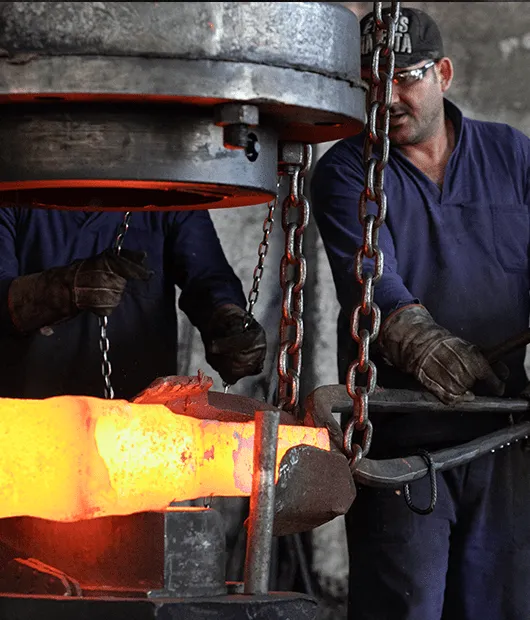
Special forgings are parts forged to drawing in alloys that require control of temperature, reduction and heat treatment: shafts, discs, rings, flanges and blocks. We forge, heat treat, test and machine in the same plant in Osasco/SP, Brazil, with an EN 10204 3.1 certificate.
What we do
- Parts up to 500 kg on the 1,000 kg hammer, from bars up to Ø 320 mm or □ 290 mm
- Plain and stepped shafts, discs, rings, bushings and blocks
- Special and non-standard flanges
- Heat treatment with a recorded cycle
- Tensile, hardness, Charpy and PMI in our own laboratory; NDT as required by the standard
- Data book with certificates and traceability from heat to part
Materials
Capacity, maximum dimensions and lead time on request: send the drawing. See alloys in stock.
Plan an open-die forging: reduction, slenderness and how much material to send →Simulate the cutting plan of the ingot or bar →Calculate the weight of bars, plates, pipes and blocks in any alloy →
Parts we make
Plain and stepped shafts, discs, rings, bushings, blocks and special flanges, always to drawing. The part leaves with machining allowance, or already rough or finish machined. For stepped shafts and headed parts we check the slenderness of the cut and, when upsetting is not safe, we forge in sections from a larger bar. The open-die forging calculator shows the weight, the starting bar and an estimated lead time.
Alloys and standards
We forge austenitic, martensitic and PH stainless, duplex and super duplex, nickel alloys, titanium, Cr-Mo steels, alloy steels and carbon steel. The most requested standards are ASTM A182 (stainless, duplex and Cr-Mo), A105 (carbon steel), A694 (high strength, such as F65), B564 (nickel alloys), B381 (titanium) and A668, plus customer specifications. Each alloy has its datasheet with composition and properties in the materials catalog.
Heat treatment, testing and data book
After forging the part receives the treatment required by the standard: normalizing, quenching and tempering, solution annealing or aging, with the cycle recorded. In our own laboratory we perform tensile, hardness, Charpy and PMI tests; NDT (ultrasonic, liquid penetrant and magnetic particle) as required by the standard. The data book gathers the mill certificate, heat treatment cycle, tests and the EN 10204 3.1 certificate of the part, traceable from heat to part.
What to send for a quotation
Send the drawing of the finished part or of the forging, the alloy and the standard, the quantity, the delivery condition (forged, heat treated, rough or finish machined) and the required tests. If there is a customer specification or inspection plan, send it too.
More in forging
Related services
Frequently asked questions
What are special forgings?
They are parts forged to drawing in alloys such as stainless, duplex, super duplex, nickel alloys, titanium and Cr-Mo steels, with standard, heat treatment and testing requirements. What changes from an ordinary forging is the alloy and the process control, from the heat to the certificate.
What is the largest forging Dustre makes?
On the 1,000 kg hammer, parts up to 500 kg, starting from bars up to Ø 320 mm. Larger parts on request.
Does Dustre forge to the customer's specification?
Yes. Besides ASTM standards (A182, A105, A694, B564, B381, A668), we meet customer specifications such as NORSOK and Petrobras, depending on the alloy. The standard and the required tests go in the quotation request.