
Forge
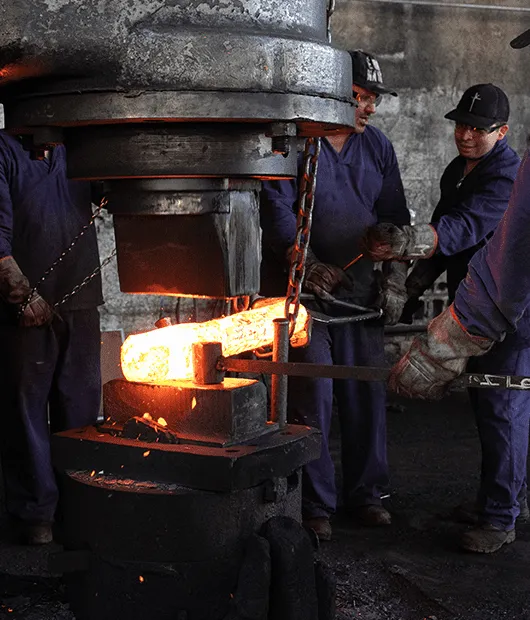
Open-die forging
We forge from the bars and blocks in our stock, with temperature and reduction control, to close porosity, refine the grain and get close to the final shape.
What we do
- 1,000 kg pneumatic hammer: bars up to Ø 320 mm or □ 290 mm and parts up to 500 kg
- Discs, rings, shafts, blocks and bushings
- Special and non-standard flanges
- Forged bars in sizes outside the market standard
- Biaxial and triaxial forging for more uniform properties
- Preforms to reduce machining and loss of expensive material
Materials
Capacity, maximum dimensions and lead time on request: send the drawing. See alloys in stock.
How open-die forging works
The billet or block is heated to the forging range of the alloy and deformed between flat or simply shaped tools, in several passes, until it approaches the final dimensions. The deformation closes solidification porosity, breaks up the as-cast structure and orients the grain flow along the loads on the part. That is why a forging has better toughness and fatigue resistance than a part machined straight from plate or from a casting.
Precautions in special alloys
Each alloy has its own temperature window. Austenitic stainless and nickel alloys work-harden fast and need frequent reheating; duplex and super duplex must stay out of the sigma phase range and always receive solution annealing after forging; titanium needs a clean furnace and atmosphere control to avoid oxygen pickup. We control the start and finish forging temperatures, the reduction applied and the subsequent heat treatment, and record everything for the traceability of the part.
From forging to finished part
The forging leaves with machining allowance and goes, in the same plant, to heat treatment, testing (hardness, tensile, Charpy, PMI) and rough or finish machining. This avoids transport between suppliers and keeps a single point of responsibility for traceability, from the mill certificate to the 3.1 certificate of the delivered part.
What to send with a quote request
Send the drawing of the finished part or of the forging, the alloy and standard (for example ASTM A182, A105, B564 or A668), the quantity, the delivery condition (heat treated, rough machined or finished) and the tests required. For simple shapes, the open-die forging calculator gives a first weight estimate.
Supply tolerances
Machining allowance and tolerance for forgings, band saw cuts, machined parts and waterjet cutting are in Dustre's tables (INF 002 and INF 003): see supply tolerances. To size the forging from the finished part, use the open-die forging calculator.
Related services
Frequently asked questions
What is the difference between open die and closed die?
In open-die forging the part is deformed between flat or simple tools, with no cavity in the final shape. It suits large parts, small lots and simple shapes. Closed-die forging uses a cavity with the shape of the part and pays off in large series.
What is the minimum forging reduction?
Starting from cast material (ingot), 3:1 is usual to close porosity and refine the grain; critical parts call for 4:1 or more. Starting from rolled or forged bar, the minimum does not apply. See the open-die forging calculator.
Is a forging better than a part machined from bar?
For large or highly loaded parts, yes: forging closes porosity and orients the grain flow to the geometry. For small, lightly loaded parts, rolled bar usually does the job at lower cost.
Does Dustre perform this service on customer-supplied material?
Yes, as long as the alloy and the specification are defined. We can also supply the material from our stock, with EN 10204 3.1 certificate.
