
Heat treatment
Quenching
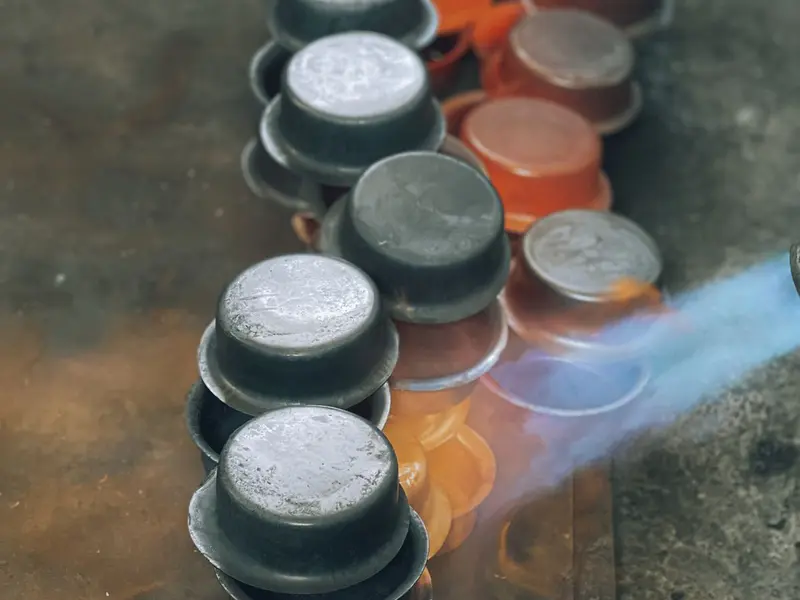
Quenching hardens the steel: it heats above the austenitizing temperature and cools quickly to form martensite. It is always followed by tempering.
What we do
- Steels 4140, 4340, 8620, F22, F91 and stainless 410, 420, 431
- Furnaces with temperature and time control and recording
- Forgings, bars, blocks and machined parts
- Report with the cycle applied and, on request, mechanical tests after treatment
Materials
Capacity, maximum dimensions and lead time on request: send the drawing. See alloys in stock.
How quenching works
The part is heated above the austenitizing temperature of the alloy, held long enough for the whole section to transform, and cooled quickly in water, oil or polymer. The fast cooling forms martensite, the hardest structure of steel. The austenitizing temperature and the quenching medium depend on the composition: more highly alloyed steels, such as 4340, harden in oil; steels of lower hardenability need a more severe medium.
Hardenability and part size
In thick sections the core cools more slowly than the surface and may not fully harden. That is why standards give properties by diameter range, and the choice of steel depends on the size of the part: 4140 serves medium sections, 4340 and steels with more nickel and molybdenum serve larger sections. Parts with sharp corners, holes and abrupt section changes have a higher risk of cracking and distortion.
Always followed by tempering
Freshly formed martensite is hard but brittle and full of stresses. Tempering, done right after quenching, adjusts the final hardness and restores toughness. On critical parts we measure the hardness after tempering and, on request, run tensile and Charpy tests.
What to send with a quote request
To get a quote, send the alloy and standard of the material, the drawing or the dimensions of the part, the quantity, the required cycle (or the hardness and properties to be reached) and whether verification tests are needed. Parts that will still be machined are treated with allowance, so that the oxidized layer is removed in finish machining.
More in heat treatment
Related services
Frequently asked questions
Can every alloy be quenched?
No. Carbon steels, alloy steels and martensitic stainless (410, 420, 431, F6NM) can be quench-hardened. Austenitic stainless, duplex and nickel alloys cannot: they harden by cold work or, in the case of PH alloys, by aging.
Does Dustre perform this service on customer-supplied material?
Yes, as long as the alloy and the specification are defined. We can also supply the material from our stock, with EN 10204 3.1 certificate.
