
Heat treatment
Aging
Aging forms fine precipitates that increase the strength of PH alloys. The temperature selects the combination of strength and toughness (H900, H1025, H1150).
What we do
- 17-4PH, 15-5PH, 17-7PH, Inconel 718, Monel K-500, A-286
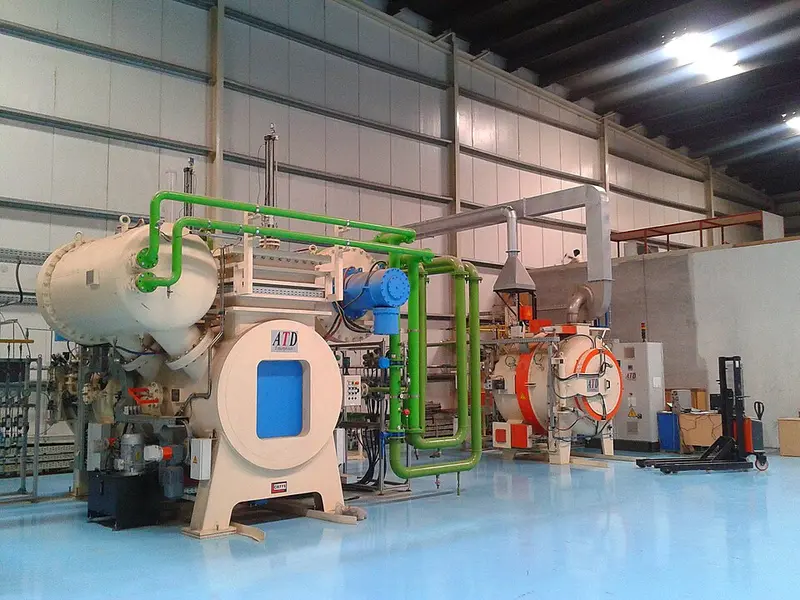
- Furnaces with temperature and time control and recording
- Forgings, bars, blocks and machined parts
- Report with the cycle applied and, on request, mechanical tests after treatment
Materials
Capacity, maximum dimensions and lead time on request: send the drawing. See alloys in stock.
How aging works
After solution annealing, the alloy is held at an intermediate temperature for a few hours. During that time very fine precipitates form (copper in 17-4PH and 15-5PH, nickel-niobium in Inconel 718, nickel-aluminum-titanium in Monel K-500 and A-286) that block dislocation movement and raise the strength, without the distortion of a quench.
The H900 to H1150 conditions
In PH steels the condition is designated by the temperature in °F: H900 gives the highest strength and the lowest toughness; H1025, H1075 and H1150 trade strength for toughness and resistance to stress corrosion cracking. For H₂S service, NACE MR0175 limits 17-4PH to the double-aged conditions (H1150D) with a defined maximum hardness. Inconel 718 has different cycles for aerospace and for oil and gas (API 6ACRA).
Machining before or after
Aging distortion is small, so many parts are machined in the solution-annealed condition and aged afterwards. For tight tolerances we leave a minimum allowance for a final finishing cut after aging.
What to send with a quote request
To get a quote, send the alloy and standard of the material, the drawing or the dimensions of the part, the quantity, the required cycle (or the hardness and properties to be reached) and whether verification tests are needed. Parts that will still be machined are treated with allowance, so that the oxidized layer is removed in finish machining.
More in heat treatment
Related services
Frequently asked questions
Which aging condition should I choose?
By the combination of strength, toughness and service medium. H900 for maximum strength; H1025 or H1150 when there is impact or a risk of stress corrosion cracking; H1150D for H₂S service.
Does Dustre perform this service on customer-supplied material?
Yes, as long as the alloy and the specification are defined. We can also supply the material from our stock, with EN 10204 3.1 certificate.
