
Heat treatment
Stress relief
Stress relief reheats the part below the transformation temperature to reduce the stresses left by welding, forging or heavy machining.
What we do
- Post-weld heat treatment (PWHT) of fabricated and welded parts
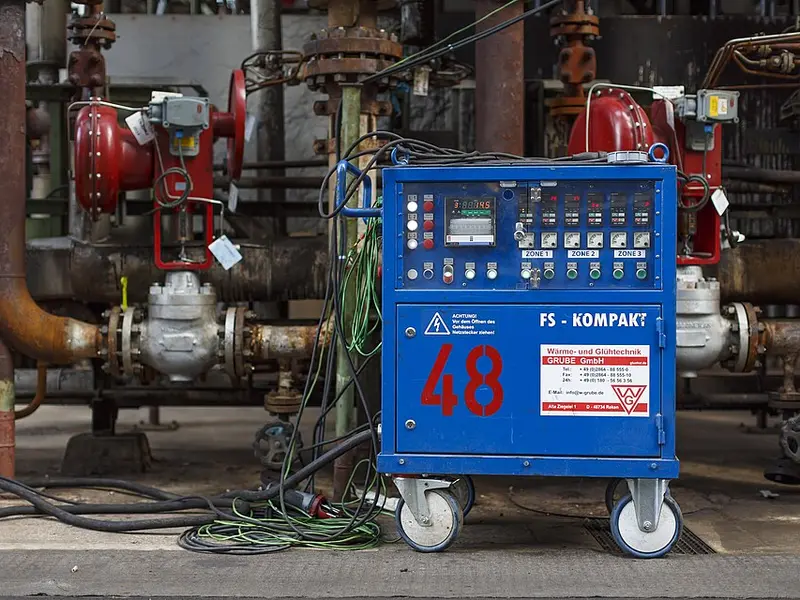
- Furnaces with temperature and time control and recording
- Forgings, bars, blocks and machined parts
- Report with the cycle applied and, on request, mechanical tests after treatment
Materials
Capacity, maximum dimensions and lead time on request: send the drawing. See alloys in stock.
How stress relief works
The part is heated below the transformation temperature (or, for non-hardenable alloys, below the recrystallization range), held until the temperature equalizes across the section and cooled slowly and in a controlled way. The heat lets the material yield locally and redistribute residual stresses, without significantly changing hardness and strength.
When it is required
Codes such as ASME Section VIII and B31.3 require post-weld heat treatment (PWHT) above certain thicknesses and for certain materials, such as Cr-Mo steels. Outside the code, stress relief is used before final machining of welded or heavily rough-machined parts, so the part does not distort after finishing, and on parts subject to stress corrosion cracking.
Precautions by alloy
The temperature changes a lot from one material to another. Carbon and Cr-Mo steels have ranges defined by the code; quenched and tempered steels must stay below the tempering temperature to avoid losing strength; austenitic stainless and duplex require care to avoid the sensitization and sigma phase ranges.
What to send with a quote request
To get a quote, send the alloy and standard of the material, the drawing or the dimensions of the part, the quantity, the required cycle (or the hardness and properties to be reached) and whether verification tests are needed. Parts that will still be machined are treated with allowance, so that the oxidized layer is removed in finish machining.
More in heat treatment
Related services
Frequently asked questions
Does stress relief reduce the hardness of the weld?
In Cr-Mo and carbon steels, yes: PWHT reduces the hardness of the heat-affected zone and the weld, which is precisely one of its goals. In quenched parts, the temperature is chosen so as not to reduce the hardness of the base metal.
Does Dustre perform this service on customer-supplied material?
Yes, as long as the alloy and the specification are defined. We can also supply the material from our stock, with EN 10204 3.1 certificate.
