
Testing laboratory
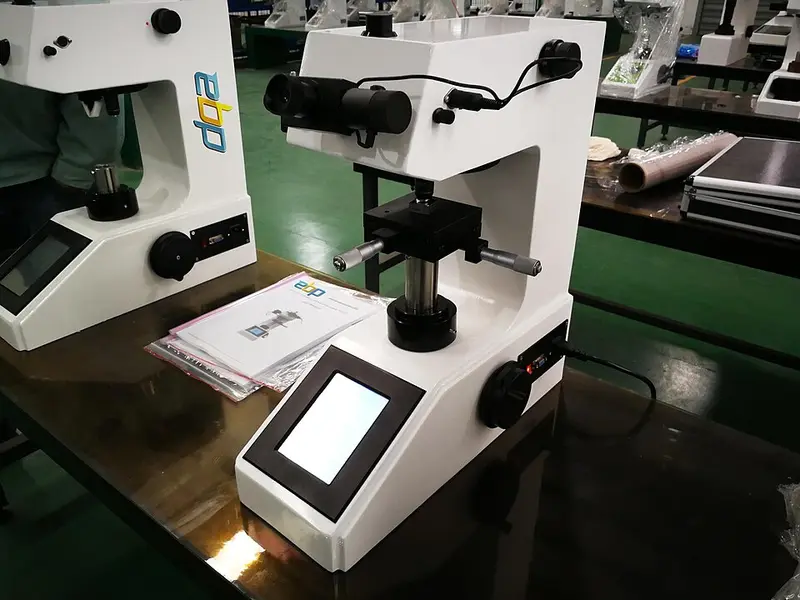
Hardness test
Hardness confirms the heat treatment and standard limits, such as the maximums of NACE MR0175 for H₂S service.
What we do
- Brinell (HB), Rockwell (HRC/HRB) and Vickers (HV)
- Checking after quenching, tempering and aging
Materials
Capacity, maximum dimensions and lead time on request: send the drawing. See alloys in stock.
How the hardness test works
An indenter is pressed against the surface with a defined load, and the hardness is calculated from the depth or size of the impression. Brinell (HB) uses a ball and suits forgings and materials with coarse structure; Rockwell (HRC, HRB) is fast and used on treated parts; Vickers (HV) uses a diamond pyramid and serves thin layers and weld zones.
What it is for
Hardness is the fastest way to confirm a heat treatment: if the quenched and tempered part is within range, the cycle worked. It is also required by service standards: NACE MR0175 / ISO 15156 sets maximum hardnesses for materials in H₂S media, such as 22 HRC for carbon and low-alloy steels and specific limits for martensitic stainless, duplex and PH alloys.
Hardness and strength
In steels, hardness has an approximate relationship with tensile strength, and conversion tables such as ASTM E140 allow estimates. The conversion does not replace the tensile test when the standard requires the measured value.
What to send with a quote request
Send the alloy, the required hardness scale, the acceptable range, the number of parts and the measurement points, if specified.
More in testing laboratory
Related services
Frequently asked questions
What is the maximum hardness for H₂S service?
It depends on the material. NACE MR0175 / ISO 15156 sets 22 HRC for carbon and low-alloy steels, 23 HRC for double-tempered F6NM stainless and specific values for duplex, PH alloys and nickel alloys. See the page of each material.
Does Dustre perform this service on customer-supplied material?
Yes, as long as the alloy and the specification are defined. We can also supply the material from our stock, with EN 10204 3.1 certificate.
