
Boilermaking, forming and welding
Plate rolling
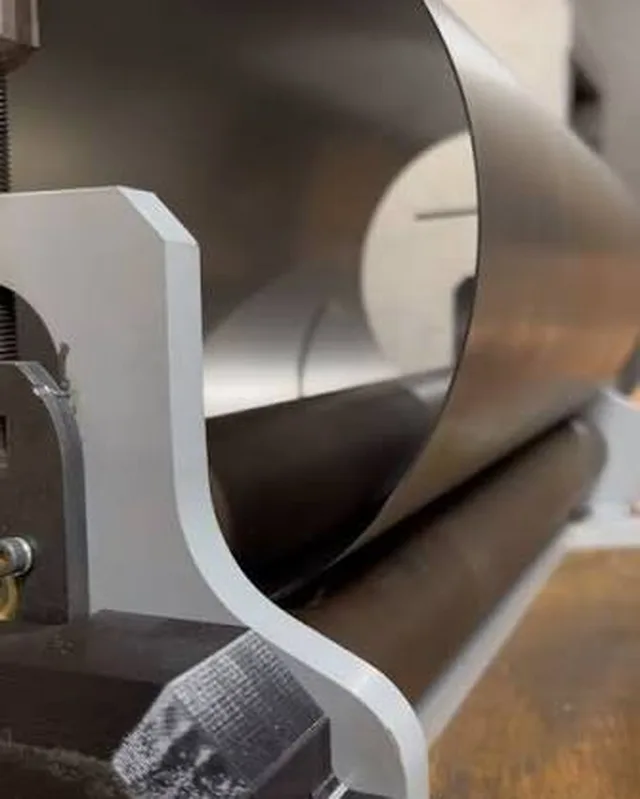
On the plate roll the plate passes between rolls and gains curvature until it forms a cylinder or a segment. It is the basis of shells, casings and plate rings.
What we do
- Shells and cylinders
- Curved segments
- Plate rings
Materials
Capacity, maximum dimensions and lead time on request: send the drawing. See alloys in stock.
How plate rolling works
The plate roll has three or four rolls. The plate passes between them several times, and the position of the rolls gradually increases the curvature until a cylinder, a cone or a curved segment is formed. The ends of the plate must be pre-bent so the cylinder closes without a straight section.
Shells, casings and rings
It is the basic process for shells and casings of vessels, tanks, exchangers and ducts, and for plate rings for large-diameter flanges and reinforcements. After rolling, the longitudinal seam is welded and the cylinder can be re-rolled to correct ovality.
Precautions in stainless and special alloys
Stainless has more springback than carbon steel and work-hardens during deformation. The rolls must be clean to avoid embedding iron in the surface, and severe rolling in stainless, duplex and nickel alloys may require solution annealing afterwards, per the equipment standard.
What to send with a quote request
Send the diameter (inside or outside), the length, the thickness, the alloy, the quantity and whether the cylinder must be delivered welded. For cones, give both diameters and the height.
More in boilermaking, forming and welding
Frequently asked questions
What is the difference between rolling and bending?
Bending creates small-radius corners at one point of the plate, on the press brake. Rolling curves the plate continuously between rolls, to form cylinders, cones and large-radius segments. Many fabrication parts use both.
Does rolled plate need heat treatment?
In carbon steel, usually not, unless the deformation exceeds the limit of the design code. In stainless, duplex and nickel alloys with severe deformation, solution annealing may be required to restore ductility and corrosion resistance.
Does Dustre perform this service on customer-supplied material?
Yes, as long as the alloy and the specification are defined. We can also supply the material from our stock, with EN 10204 3.1 certificate.
