
Machining
Turning
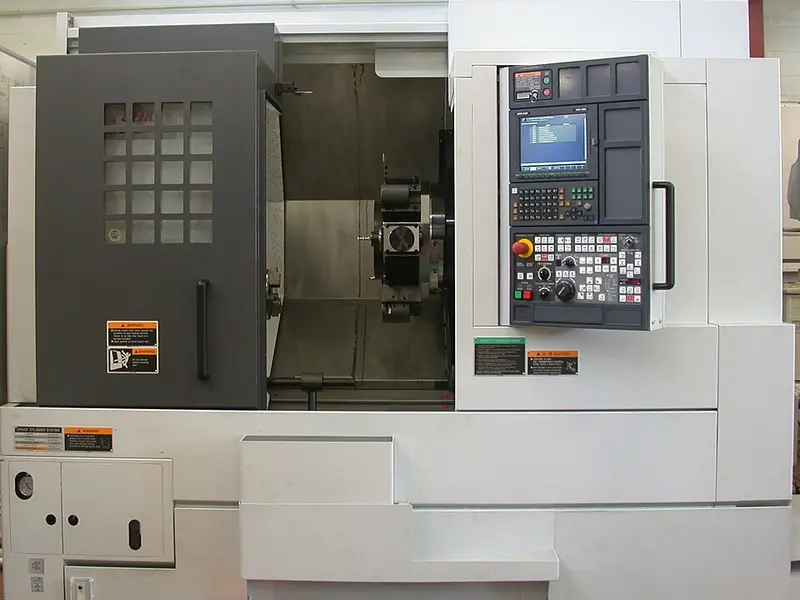
In turning the part rotates and the tool removes material to form diameters, faces, threads and grooves.
What we do
- Shafts and stems
- Flanges, rings and discs
- Bushings and sleeves
- Threads and sealing grooves (RTJ)
Materials
Capacity, maximum dimensions and lead time on request: send the drawing. See alloys in stock.
How turning works
The part is clamped in the chuck and rotates, while the tool moves along and toward the axis to generate diameters, faces, tapers, radii, threads and grooves. It is the basic process for every cylindrical part: shafts, stems, discs, rings, bushings, sleeves and flanges.
Turning difficult alloys
In stainless, duplex and nickel alloys, the key is to keep the tool cutting: enough depth and feed to get under the work-hardened layer of the previous pass, positive geometry and constant coolant. In titanium, the cutting speed is low and the coolant prevents the risk of fine chips igniting. Long, slender parts require a steady rest and tailstock to avoid vibration.
Finishes and seals
Flange faces receive the serrated or smooth finish required by ASME B16.5, and RTJ ring grooves follow the standard dimensions. NPT, BSP, UN and metric threads are machined and checked with gauges.
What to send with a quote request
To get a quote, send the drawing with tolerances and surface finish, the alloy and standard, the quantity and whether the part starts from bar, from a forging or from material you supply. Parts in special alloys are usually cheaper when the forging is already made close to the final shape, and we do both steps.
Supply tolerances
Machining allowance and tolerance for forgings, band saw cuts, machined parts and waterjet cutting are in Dustre's tables (INF 002 and INF 003): see supply tolerances. To size the forging from the finished part, use the open-die forging calculator.
More in machining
Related services
Frequently asked questions
Do you machine RTJ ring grooves?
Yes. Grooves for RTJ rings (R, RX and BX) are machined to the dimensions of ASME B16.20 and B16.5 or API 6A, with the finish required for sealing.
Do you make long shafts in stainless and alloys?
Yes, from bars and forgings in stock. The maximum length and diameter are confirmed in the quote.
Does Dustre perform this service on customer-supplied material?
Yes, as long as the alloy and the specification are defined. We can also supply the material from our stock, with EN 10204 3.1 certificate.
