
Machining
Milling
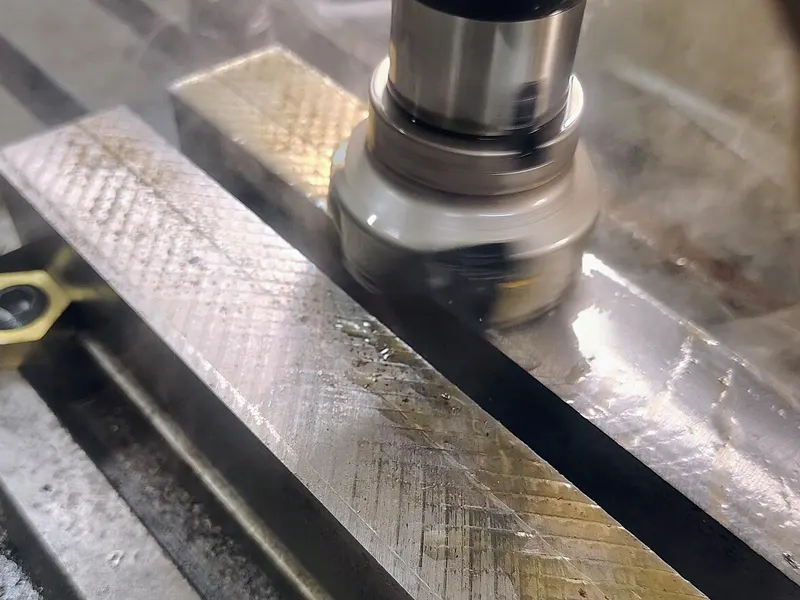
In milling the tool rotates and removes material from flat faces, slots, pockets and profiles.
What we do
- Squared blocks and plates
- Keyways and pockets
- Flat and parallel faces
Materials
Capacity, maximum dimensions and lead time on request: send the drawing. See alloys in stock.
How milling works
In milling the tool rotates and the part moves relative to it, in two or more axes. It is the process for flat surfaces, keyways, pockets, profiles, squaring of blocks and all details that are not of revolution.
Milling special alloys
Forged blocks of stainless, duplex, F11, F22 and nickel alloys arrive with forging skin and variable hardness. Roughing uses robust cutters with carbide inserts and a smooth entry into the part; finishing uses sharp tools and constant feed so as not to work-harden the surface. Large parts are turned over and realigned to ensure parallelism and squareness.
Combination with other processes
Many parts combine turning and milling: flanges with slots, shafts with keyways, valve bodies and manifold blocks. We also mill plates and tubesheets that then go to drilling.
What to send with a quote request
To get a quote, send the drawing with tolerances and surface finish, the alloy and standard, the quantity and whether the part starts from bar, from a forging or from material you supply. Parts in special alloys are usually cheaper when the forging is already made close to the final shape, and we do both steps.
Supply tolerances
Machining allowance and tolerance for forgings, band saw cuts, machined parts and waterjet cutting are in Dustre's tables (INF 002 and INF 003): see supply tolerances. To size the forging from the finished part, use the open-die forging calculator.
More in machining
Frequently asked questions
Do you mill titanium parts?
Yes. Titanium is milled with low cutting speed, sharp tools and abundant coolant, which also prevents the risk of fine chips igniting.
Milling or waterjet cutting?
For flat contours in plate, waterjet is faster and cheaper. Milling comes in when there are depths, slots, pockets or tolerances that cutting cannot reach.
Do you supply squared blocks for the customer to machine?
Yes. Forged blocks or blocks cut from heavy plate can leave only squared, with the allowance defined by the customer.
Does Dustre perform this service on customer-supplied material?
Yes, as long as the alloy and the specification are defined. We can also supply the material from our stock, with EN 10204 3.1 certificate.
