
ASME B16.5 flanges: types, classes and tables
ASME B16.5 standardizes flanges from NPS ½ to 24 in seven pressure classes. Choose the class to see all dimensions, bolt pattern, weight and allowable pressure.
Tables by pressure class
Class 150NPS ½ to 24 · 19.6 bar in A105 at 38 °C · raised face 1.6 mmClass 300NPS ½ to 24 · 51.1 bar in A105 at 38 °C · raised face 1.6 mmClass 400NPS ½ to 24 · 68.1 bar in A105 at 38 °C · raised face 6.4 mmClass 600NPS ½ to 24 · 102.1 bar in A105 at 38 °C · raised face 6.4 mmClass 900NPS ½ to 24 · 153.2 bar in A105 at 38 °C · raised face 6.4 mmClass 1,500NPS ½ to 24 · 255.3 bar in A105 at 38 °C · raised face 6.4 mmClass 2,500NPS ½ to 12 · 425.5 bar in A105 at 38 °C · raised face 6.4 mm Above NPS 24ASME B16.47 Series A and B, NPS 26 to 60
Flange types
| Type | How it connects | When to use | Range in class 150 |
|---|---|---|---|
| Weld neck WN | Butt welded to the pipe. The tapered hub distributes the stresses. | High pressure, high temperature, thermal cycling and fatigue. | NPS ½ to 24 |
| Slip-on SO | Slips over the pipe and takes two fillet welds (inside and outside). | Moderate service; cheaper and easier to align. | NPS ½ to 24 |
| Socket weld SW | The pipe fits into the flange socket and takes one external fillet weld. | Small-diameter, high-pressure lines. | NPS ½ to 3 |
| Threaded TH | Tapered NPT thread, no welding. | Where welding is not possible; low vibration and low temperature. | NPS ½ to 24 |
| Lap joint LJ | Loose, works with a stub end welded to the pipe. | Frequent assembly and disassembly; carbon steel flange with stub end in the noble alloy. | NPS ½ to 24 |
| Blind BL | Disc without a central bore. | Closes lines, nozzles and vessels; hydrostatic test point. | NPS ½ to 24 |
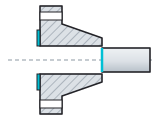
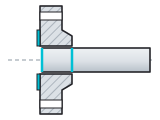
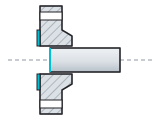
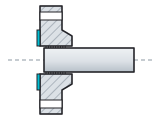
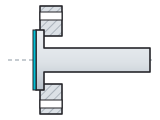
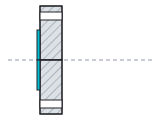
Section drawings, not to scale: in blue, the sealing face and the weld point.
Map: type × class
Click a cell to open the table for that type in the chosen class.
| Type | 150 | 300 | 400 | 600 | 900 | 1,500 | 2,500 |
|---|---|---|---|---|---|---|---|
| WN | ½ to 24 | ½ to 24 | ½ to 24 | ½ to 24 | ½ to 24 | ½ to 24 | ½ to 12 |
| SO | ½ to 24 | ½ to 24 | ½ to 24 | ½ to 24 | ½ to 24 | ½ to 2½ | – |
| SW | ½ to 3 | ½ to 3 | ½ to 3 | ½ to 3 | ½ to 2½ | ½ to 2½ | – |
| TH | ½ to 24 | ½ to 24 | ½ to 24 | ½ to 24 | ½ to 24 | ½ to 2½ | ½ to 2½ |
| LJ | ½ to 24 | ½ to 24 | ½ to 24 | ½ to 24 | ½ to 24 | ½ to 24 | ½ to 12 |
| BL | ½ to 24 | ½ to 24 | ½ to 24 | ½ to 24 | ½ to 24 | ½ to 24 | ½ to 12 |
Face types
| Face | Form | Application |
|---|---|---|
| Raised face (RF) | 1.6 mm raised face (classes 150 and 300) or 6.4 mm (400 and above). | Standard for most applications, with spiral-wound or sheet gasket. |
| Flat face (FF) | No raised face. | Connection to cast iron flanges, pumps and fragile equipment. |
| Ring type joint (RTJ) | Machined groove for a metal ring. | High pressure and temperature, oil and gas. |
| Male and female / tongue and groove | Mating faces that confine the gasket. | Corrosive or toxic fluids, confined gasket. |
Frequently asked questions
What is the difference between class 150, 300 and 600?
It is the pressure class. The higher the class, the higher the allowable pressure and the thicker and heavier the flange. In A105 at 38 °C: class 150 allows 19.6 bar, class 300 allows 51.1 bar and class 600 allows 102.1 bar.
Up to what diameter does ASME B16.5 go?
Up to NPS 24 (class 2500 up to NPS 12). Above NPS 24, ASME B16.47 applies, Series A and B.
Which flange to choose: WN or SO?
WN for high pressure, temperature or fatigue; SO for moderate service, when cost and assembly matter more.
B16.5 flanges in special alloysStainless, duplex, super duplex, nickel alloys and Cr-Mo steels, forged and machined at Dustre, with 3.1 certificate.
Request a quote 